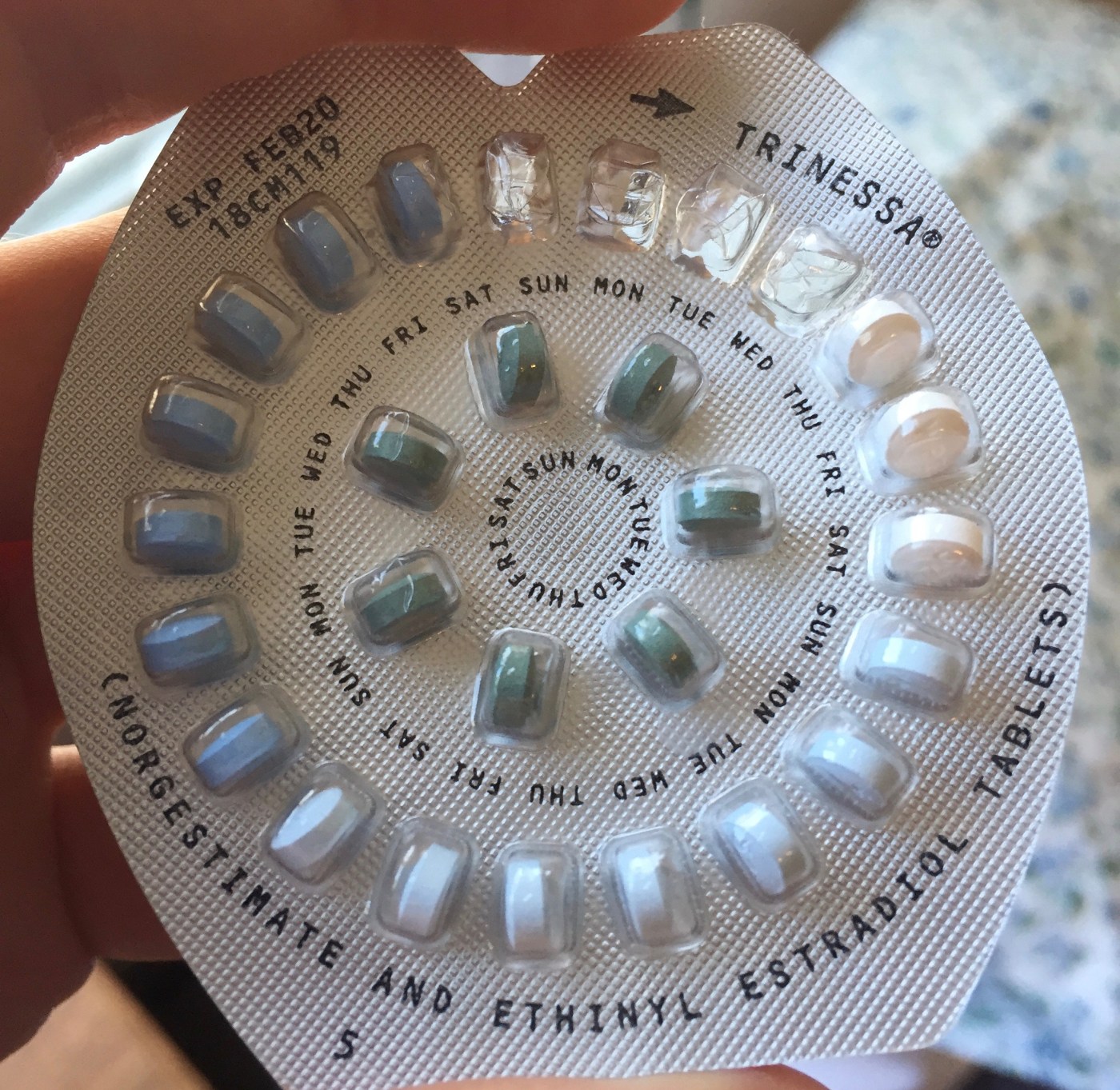
Photo courtesy of UW-Madison student Elizabeth Peterson. Peterson takes birth control pill daily.
10 Things to Know Before Going on Birth Control
By Juliet Dupont

Deciding to go on birth control is a big decision, and it can also be a difficult one. There are at least a dozen different options, and you might not know how your body will react to any of them. Keep reading for 10 things to know at the beginning of your journey with contraceptives at the University of Wisconsin-Madison.
1. Contraceptives aren’t just for preventing pregnancy
Don’t let the term “birth control” fool you. Contraceptives aren’t just for the sexually active! Contraception can be used for preventing pregnancy, but it can also be used for controlling acne and lightening heavy menstrual bleeding.
2. University Health Services offers several contraceptive options
The University Health Services (UHS) Women’s Clinic offers a variety of birth control options for women on campus and provides consultations, prescriptions, and insertions and removals of all contraceptive devices.
All Women’s Health Clinic visits are confidential and free, but certain medications and contraceptive devices have charges that require insurance or patient assistance programs.
3. The UHS Women’s Clinic offers more than one way to access contraceptives
College students are busy! To maximize access to contraceptive services and resources, UHS offers Telehealth visits in which students can set up a time to speak with a UHS medical professional over the phone.
During your Telehealth appointment, UHS can provide you with a prescription, information about contraception and advice on how to access non-prescription contraceptive methods.
4. Not all contraceptives are created equal
Scheduling an appointment at the Women’s Clinic to get access to contraceptives may be easy and free, but do your research before heading to 333 East Campus Mall for your appointment!
Some contraceptives are much more effective than others, but there are other factors involved such as cost, convenience and how your body reacts to different contraceptives.
The three most effective options offered by the UHS Women’s Clinic include:
- Hormonal implant
- A hormonal implant is a small rod about the size of a matchstick. After a doctor inserts the implant into your upper arm, it releases hormones into your body that prevent you from getting pregnant.
- Hormonal implants last for four years and are 99 percent effective in preventing pregnancy.
- Intrauterine device (IUD)
- An IUD is a device shaped like a T, and there are two types: copper and hormonal. Both types of IUD change the way sperm cells move and prevent them from reaching the egg.
- Depending on the type you get, an IUD can last up to 12 years. IUDs are 99 percent effective in preventing pregnancy.
- Depo-Provera shot
- This shot contains progestin, a hormone that prevents your body from releasing an egg.
- No egg, no pregnancy! The shot must be injected by a doctor every three months, and it is 94 percent effective.
5. What works for your best friend might not work for you
The three options listed above can be great for busy college students who want a low-maintenance contraceptive option, but it’s important to remember that they’re not the only options.
Every contraceptive method is a little different, and every woman’s body is a little different. Your friend may love her Sprintec birth control pills, but that doesn’t necessarily mean you will too! Explore all your options and talk to a medical professional before settling on a contraceptive method.
6. There are side effects
There are positive side effects to using birth control such as help with acne, lighter periods and fewer cramps, but there are also negative side effects to be aware of with hormonal birth control methods.
Spotting — bleeding between periods — is common for those who use Depo-Provera shots, IUDs, implants and pills. Many women who use forms of hormonal birth control also struggle with headaches, nausea, sore breasts, changes in sex drive and weight gain.
7. Your habits matter
Do you constantly forget to put your retainers on at night, plug your laptop in or grab your earbuds off the kitchen table on your way out the door for class? If so, take those forgetful habits into account when you’re thinking about which birth control method would work best within your lifestyle.
Birth control pills have to be taken around the same time each day. If you’re forgetful or your schedule varies throughout the week, consider an IUD or Depo-Provera shot.
If you want to start out slow with contraceptives, however, the pill is great because you can stop taking it whenever you want. Read these tips for reminding yourself to take your pill each day.
8. Getting an IUD inserted can be painful
IUDs are extremely effective and used by 40 percent of gynecologists, but the insertion can be fairly painful. The pain is something to be aware of, but only one of several factors to consider in your decision to opt for an IUD or not.
Be sure to think about the cost, the convenience, the side effects and your doctor’s recommendation as well as the insertion process when you decide!
9. Pulling out is not an effective method of birth control
After reading all this, you may be thinking, “Why go through all the trouble of getting birth control if he can just pull out before ejaculating?” After all, pulling out is free, doesn’t require a prescription and doesn’t have any of the side effects hormonal birth control methods have.
However, contraceptives are a much more effective option for preventing pregnancy. Even if your partner plans to pull out prior to ejaculation, he could time it wrong, or pre-ejaculation fluid could contain sperm. If you’re trying to avoid pregnancy, don’t risk it!
Condoms are a perfect place to start. While no contraceptive method is perfect, condoms do a pretty good job of preventing pregnancy, protecting you from STIs and building good habits for a healthy sex life.
10. You can stop using certain contraceptives whenever you want
IUDs can be removed, and you can stop taking birth control pills in the middle of your pill pack if you want to.
With certain birth control methods, you are in control of the process and have the ability to make sure that your contraceptive method is working for you. At the end of the day, that’s what your contraceptive is supposed to be doing. It’s supposed to be making your daily life and certain things in it, including sex, acne, cramps and particularly heavy flows, easier.
Now that you know 10 more things about birth control at UW-Madison, proceed with confidence and live your best, healthiest life.
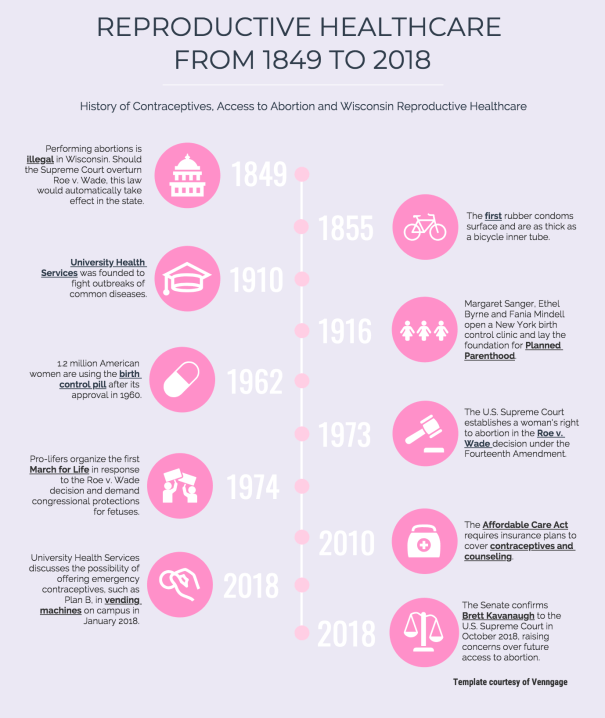
A History of Reproductive Healthcare
Reproductive healthcare has a long, complicated history with many legal battles, court decisions, inventions and organizations.
Click on the image below to take a look at a timeline of a few key developments in reproductive healthcare from 1849 to 2018.
 Your UW Reproductive Health